

Table of Contents
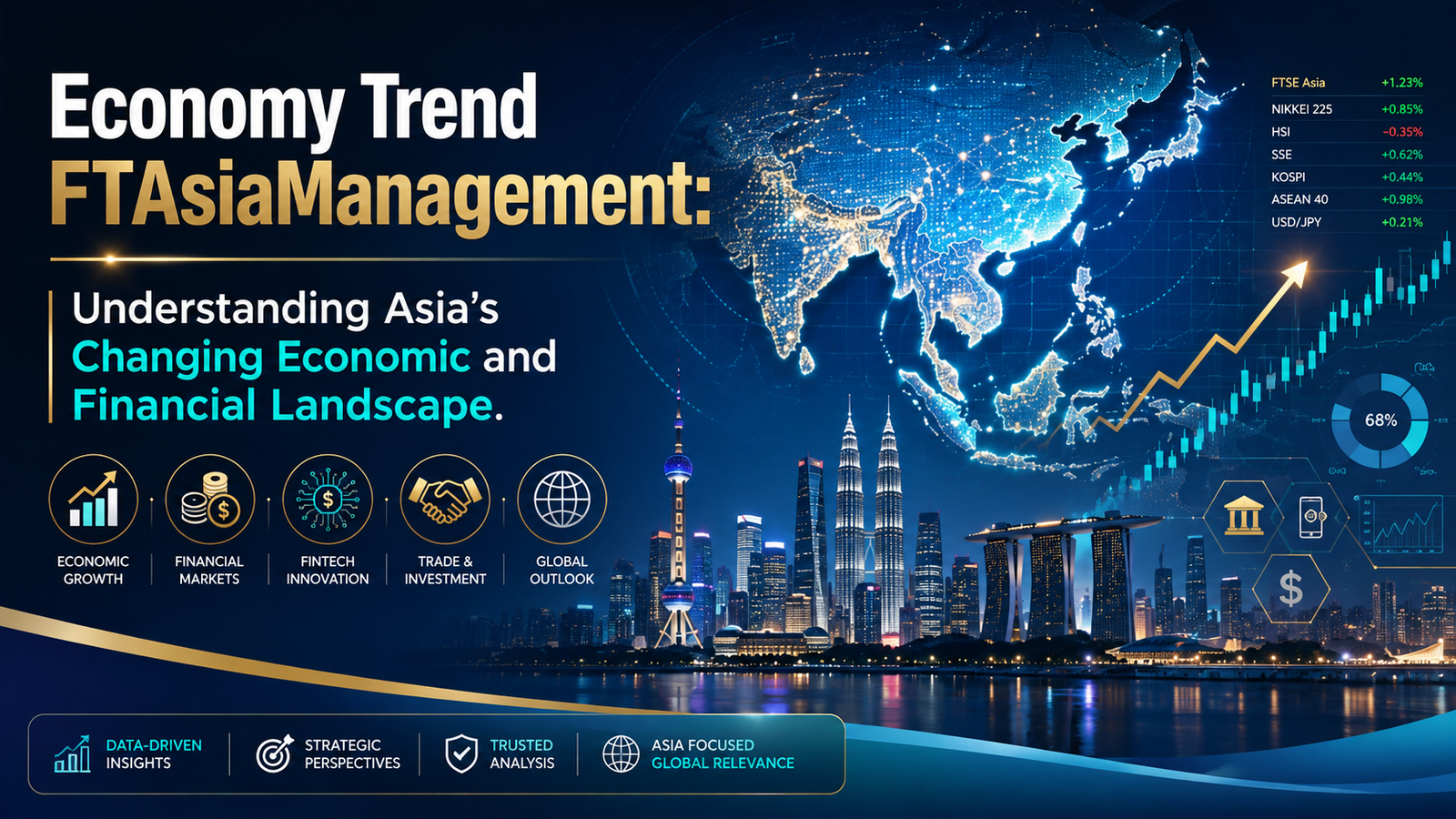
The global economy is being reshaped by technological innovation, changing consumer behaviour, geopolitical uncertainty, digital payments, inflation, artificial intelligence and shifting international trade patterns. Within this environment, the term economy trend FTAsiaManagement has started appearing in online discussions about Asian markets, fintech development and financial decision-making.
The phrase does not refer to an official economic indicator, government programme or internationally recognised financial index. Based on publicly indexed pages, it is primarily used as a topic label by several FTAsiaManagement-related websites covering technology, finance, cryptocurrency, business and regional economic developments. (FTAsiaManagement)
A practical way to understand the term is to view it as a framework for following the forces influencing Asian economies. These forces include GDP growth, interest rates, inflation, digital transformation, consumer demand, investment flows, trade policies and financial technology adoption.
This article explains what the phrase means, why people search for it and how businesses, investors and ordinary readers can use economic information more responsibly.
What Does Economy Trend FTAsiaManagement Mean?
The phrase economy trend FTAsiaManagement can be interpreted as the study of economic, financial and technological developments affecting Asian countries and their connections with the global economy.
It brings together traditional macroeconomic indicators and newer digital signals. Traditional indicators include gross domestic product, employment, inflation, trade balances, industrial output and central bank policies. Newer signals include mobile payment adoption, digital lending, fintech investment, artificial intelligence, e-commerce growth and cryptocurrency regulation.
FTAsiaManagement-related websites commonly position themselves as information platforms covering finance, technology, money management, cryptocurrency and economic developments. However, readers should understand that information published on such websites is commentary rather than an official substitute for data issued by central banks, government statistical agencies, the World Bank, the International Monetary Fund or the Asian Development Bank. (FTAsiaManagement)
Therefore, the phrase should be treated as a broad research topic. It may help readers discover economic commentary, but any important financial or business decision should be checked against primary and authoritative sources.
Why Economy Trend FTAsiaManagement Is Gaining Attention
Interest in economy trend FTAsiaManagement reflects a much larger demand for understandable economic information. People want to know why prices are rising, whether interest rates may change, which industries are expanding and how technology could affect their income or business.
Asia is particularly important because it includes major manufacturing centres, rapidly growing consumer markets, established financial hubs and some of the world’s most active digital economies. Developments in China, India, Japan, South Korea and Southeast Asia can influence supply chains, commodity prices, technology investment and global trade.
Economic conditions across Asia are not uniform. A country dependent on energy imports may face different pressures from an economy that exports oil, electronics or agricultural goods. Likewise, a country with a young population may experience stronger consumer growth than one dealing with population ageing.
The value of this topic lies in connecting those differences. Instead of looking at one headline, readers can examine several indicators together and understand what they may mean for businesses, households and financial markets.
The Current Asian Economic Backdrop
The wider backdrop for economy trend FTAsiaManagement is a region that continues to grow but faces significant differences between countries and subregions.
The Asian Development Bank’s July 2026 outlook forecast growth of approximately 4.9% for developing Asia and the Pacific in 2026. The World Bank, using the narrower East Asia and Pacific regional definition, projected growth of approximately 4.2% for 2026. These figures are not contradictory because the institutions cover different groups of economies and use separate methodologies. (World Bank)
Growth remains supported by domestic consumption, services, technology investment and manufacturing. At the same time, economic performance is being affected by energy costs, trade restrictions, weaker external demand, property-market difficulties in some economies and uncertainty surrounding geopolitical events.
| Economic factor | Possible positive effect | Possible negative effect |
| Consumer spending | Supports retail, services and employment | Can weaken when prices or borrowing costs rise |
| Technology investment | Improves productivity and creates new industries | May increase inequality between skilled and unskilled workers |
| Export demand | Supports manufacturing and foreign exchange earnings | Creates exposure to global downturns |
| Infrastructure development | Improves connectivity and business activity | Can increase debt when projects are poorly selected |
| Digital finance | Expands access to payments and credit | May introduce cybersecurity and consumer-protection risks |
| Energy prices | Benefit energy-exporting economies | Raise costs for energy-importing countries |
A responsible analysis must therefore move beyond the idea that Asia is either “booming” or “slowing.” Both conditions can exist at the same time in different industries and countries.
Key Indicators Used to Read Economic Trends
Anyone researching economy trend FTAsiaManagement should understand the indicators commonly used to evaluate economic direction. No single statistic can describe an entire economy, so indicators must be interpreted together.
GDP growth measures changes in the value of goods and services produced. Inflation shows how quickly average prices are rising. Interest rates influence borrowing, investment, property demand and currency values. Employment data reveal whether growth is creating opportunities for workers.
Trade figures are also important because many Asian economies depend heavily on manufacturing and exports. Industrial production, purchasing managers’ indexes, shipping activity and export orders can provide early clues about business conditions.
| Indicator | What it measures | Why it matters |
| GDP growth | Expansion or contraction in economic output | Shows the broad direction of the economy |
| Consumer inflation | Changes in household prices | Affects purchasing power and interest-rate policy |
| Interest rates | Cost of borrowing money | Influences loans, investment and asset prices |
| Employment | Labour-market strength | Indicates income stability and consumer demand |
| Retail sales | Household spending activity | Helps measure consumer confidence |
| Industrial output | Manufacturing and production levels | Important for export-oriented economies |
| Exchange rates | Value of one currency against another | Affects imports, exports and foreign investment |
| Business confidence | Expectations of companies | Can indicate future hiring and investment |
| Trade balance | Difference between exports and imports | Shows external demand and currency pressures |
| Credit growth | Expansion in household and business lending | Can support activity but also increase financial risk |
Indicators should also be compared over time. A single month of weak exports may not indicate a recession, just as one strong quarter does not guarantee lasting growth.
Inflation, Interest Rates and Household Purchasing Power
Inflation is central to economy trend FTAsiaManagement because it directly affects daily life. When food, fuel, housing and transportation costs increase faster than wages, households lose purchasing power.
Central banks often respond to persistent inflation by raising interest rates. Higher rates can reduce demand and slow price growth, but they also make mortgages, business loans and consumer credit more expensive. This creates a difficult balance between controlling inflation and protecting economic growth.
Inflation patterns differ across Asia. Some economies are more vulnerable to imported energy and food prices, while others have stronger domestic supply networks or government support systems. The Asian Development Bank expected South Asian inflation to increase from 2.9% in 2025 to approximately 5% in 2026, largely reflecting higher food and energy costs. (ADB)
Readers should therefore examine both headline inflation and core inflation. Headline inflation includes volatile food and energy prices, while core measures attempt to reveal underlying price pressure. Wage growth, rental costs and inflation expectations also deserve attention because they can influence how long inflation remains elevated.
Digital Payments and the Transformation of Finance
Digital finance is one of the strongest themes connected with economy trend FTAsiaManagement. Mobile wallets, instant bank transfers, QR payments and embedded financial services are changing how people and businesses handle money.
The Bank for International Settlements has documented how digital technologies are transforming payments, lending, insurance and wealth management. These developments can improve efficiency, competition and financial inclusion, although they may also increase market concentration and create new regulatory risks. (Bank for International Settlements)
In parts of Southeast Asia, interoperable QR payment systems and mobile wallets are making small transactions faster and more convenient. Cross-border payment initiatives are also being developed to reduce the cost and complexity of transferring money between countries. (Bank for International Settlements)
For small businesses, digital payments can improve record-keeping, reduce dependence on cash and make online selling easier. For consumers, they provide convenience and access to financial services. However, weak passwords, fraudulent applications, identity theft and unclear lending terms remain serious concerns.
Digital growth should therefore be measured not only by transaction volume but also by security, affordability, reliability and consumer trust.
Artificial Intelligence and Productivity Growth
Artificial intelligence has become another major component of economy trend FTAsiaManagement because it can influence productivity, employment and business competitiveness.
Companies are using AI for customer support, fraud detection, demand forecasting, inventory management, marketing, translation and data analysis. Large businesses may use sophisticated models, while smaller companies increasingly access AI through affordable cloud-based tools.
The potential economic benefit comes from completing repetitive tasks more efficiently and helping employees make faster decisions. However, the results depend on data quality, management practices, employee skills and responsible implementation.
AI adoption does not automatically produce productivity growth. A company may purchase expensive software without redesigning its workflows or training employees. In that situation, costs rise while output remains unchanged.
The World Bank has noted that the AI boom is encouraging trade and investment in East Asia and the Pacific, but gaps in connectivity and skills can limit the region’s ability to capture the benefits. (World Bank)
The most successful economies are likely to be those that combine digital infrastructure with education, cybersecurity, competitive markets and practical workforce training.
Trade, Supply Chains and Regional Integration
Trade remains essential to economy trend FTAsiaManagement because Asia plays a major role in global manufacturing and supply chains.
Semiconductors, electronics, vehicles, machinery, textiles, pharmaceuticals and consumer goods often pass through several Asian economies before reaching customers. A disruption in one country can therefore affect production schedules and prices elsewhere.
Businesses have responded to recent uncertainty by diversifying suppliers, holding larger inventories and locating production closer to important markets. This does not mean globalisation has ended. Instead, companies are placing greater value on supply-chain resilience.
Regional integration may also become more important. Faster customs procedures, improved transport networks and better cross-border payment systems can reduce transaction costs. However, businesses must still manage different tax rules, technical standards, currencies and regulatory requirements.
Trade restrictions create additional uncertainty. Tariffs may protect selected domestic industries, but they can also raise input costs for companies that depend on imported components. The final effect depends on whether local suppliers can provide comparable products at competitive prices.
A reliable economic analysis should therefore examine both export performance and the imported materials required to produce those exports.
Consumer Behaviour and the Growth of Digital Commerce
Consumer behaviour provides another important lens for studying economy trend FTAsiaManagement. Economic growth becomes more sustainable when households have stable incomes and enough confidence to spend.
Asian consumers are increasingly combining physical and digital shopping. They may discover products through social media, compare prices on marketplaces, pay through mobile wallets and collect purchases from local stores. This has created opportunities for retailers, logistics companies, payment providers and independent online sellers.
However, consumer spending can weaken when food, fuel, rent or loan payments absorb a larger share of household income. Confidence may also decline when people fear unemployment or economic instability.
Businesses should avoid assuming that a growing digital market guarantees easy profits. Online competition is intense, advertising costs can rise quickly and customers can compare brands within seconds.
The strongest companies use consumer data responsibly, offer transparent prices and provide dependable customer service. They also understand that price sensitivity varies by income group, age, location and product category.
Digital commerce is therefore not only a technology story. It is also a story about trust, affordability, logistics and household purchasing power.
The Role of Small and Medium-Sized Businesses
Small and medium-sized enterprises are central to economy trend FTAsiaManagement because they create employment, support local supply chains and introduce competition.
SMEs often respond quickly to changing customer needs, but they may have limited cash reserves and weaker access to affordable financing. Rising interest rates, delayed customer payments or sudden increases in material costs can place significant pressure on them.
Financial technology may help by offering digital invoicing, online payments and alternative credit assessment. Research published by the Bank for International Settlements suggests that fintech services can expand access to payments and financial products, particularly for underserved customers and informal businesses. (Bank for International Settlements)
Nevertheless, easier credit is not always safer credit. A loan with a high effective cost can damage a business whose cash flow is already unstable. SME owners should compare repayment terms, fees and penalties instead of focusing only on how quickly funds can be approved.
Governments can support smaller companies through reliable infrastructure, simpler regulation, skills development and fair access to public procurement. Sustainable SME growth depends on a healthy business environment rather than temporary financial support alone.
Investment Patterns and Capital Allocation
Investment is frequently discussed in relation to economy trend FTAsiaManagement, but the word “investment” covers many different activities.
Foreign direct investment may finance factories, offices, data centres and infrastructure. Portfolio investment may flow into shares and bonds but can leave quickly when market conditions change. Domestic investment may come from businesses, households, banks or governments.
Investors generally examine growth prospects, political stability, currency risk, regulation, market size and the quality of institutions. Technology businesses may attract capital because of their expansion potential, while infrastructure projects may appeal to investors seeking long-term income.
Economic excitement should not replace due diligence. A fast-growing industry can still contain weak companies, unrealistic valuations and poor governance. Likewise, a slow-growing sector may include stable businesses with dependable cash flow.
Investors should distinguish between structural and temporary trends. Population growth, urbanisation and digital adoption may develop over many years. Commodity-price movements, market rumours and short-term policy announcements may disappear much faster.
The quality of capital allocation matters as much as the quantity. Investment supports long-term growth when it improves productivity and creates sustainable economic value.
Cryptocurrency and Digital Asset Risks
Cryptocurrency is often mentioned alongside economy trend FTAsiaManagement, particularly on websites covering fintech and digital finance. However, crypto-market activity should not be treated as a direct measure of economic health.
Digital asset prices can rise or fall rapidly because of speculation, liquidity, regulation, investor sentiment and platform-specific events. A rising cryptocurrency market does not necessarily mean wages, production or employment are improving.
Blockchain technology may support payment settlement, tokenisation and record management, but the usefulness of a blockchain project depends on its design, governance and real-world purpose. The presence of technical language is not proof of financial value.
Readers should be especially cautious about platforms promising guaranteed profits, secret trading methods or unusually high returns. Security risks may include phishing, stolen passwords, fake applications, market manipulation and the loss of private keys.
Regulatory approaches also differ across Asian jurisdictions. Some governments permit selected digital asset activities under licensing systems, while others impose stricter restrictions.
Cryptocurrency should therefore be analysed as one small part of the wider financial system rather than the foundation of an economic outlook.
Economic Risks That Readers Should Monitor
Any balanced discussion of economy trend FTAsiaManagement must include downside risks. Economic forecasts are based on assumptions, and unexpected events can change the outlook quickly.
Energy-price shocks can raise transportation, electricity and manufacturing costs. Trade restrictions can weaken exports. Currency depreciation can make imported goods more expensive, while excessive debt may limit the ability of governments and businesses to respond to downturns.
Property-market weakness can affect construction, banking and household confidence. Cyberattacks can interrupt financial systems and damage trust in digital services. Climate-related disasters can affect agriculture, infrastructure and supply chains.
Demographic change is another long-term concern. Some Asian economies have young and expanding workforces, while others face ageing populations and shrinking labour supplies. Each situation requires different policies.
The key is not to predict every crisis. It is to build resilience. Companies can diversify suppliers, maintain emergency liquidity and test contingency plans. Households can limit expensive debt and protect essential savings. Policymakers can strengthen institutions and provide clear information.
Risk awareness should support better decisions, not create unnecessary fear.
How to Evaluate Economy Trend FTAsiaManagement Information
Readers searching for economy trend FTAsiaManagement may encounter articles containing confident predictions, investment claims or impressive statistics. Those claims should be evaluated carefully.
| Evaluation question | Strong information | Warning sign |
| Who published it? | Identifiable organisation or qualified author | No author or unclear ownership |
| Where does the data come from? | Central bank, statistical agency or recognised institution | No original source |
| Is the date visible? | Clear publication and data period | Undated claims |
| Is uncertainty explained? | Forecast assumptions and limitations are disclosed | Prediction presented as guaranteed |
| Are different countries separated? | Regional differences are acknowledged | Asia treated as one identical market |
| Is financial promotion involved? | Risks and conflicts are disclosed | Pressure to buy immediately |
| Can the claim be verified? | Links or citations lead to primary evidence | Repeated claims without documentation |
Readers should compare commentary with primary data from organisations such as the Asian Development Bank, World Bank, International Monetary Fund, national statistical agencies and central banks.
It is also important to check the date of the underlying information. An article published recently may still rely on outdated statistics. Conversely, an older research paper may remain useful when it explains a stable economic principle.
Trustworthy analysis separates verified facts from forecasts and personal opinions.
A Practical Framework for Businesses and Investors
The most useful application of economy trend FTAsiaManagement is not predicting the future with perfect accuracy. It is building a structured process for responding to change.
A business can begin by identifying the economic indicators that affect its revenue and costs. A retailer may focus on consumer confidence, inflation and household income. A manufacturer may prioritise exchange rates, energy costs, export demand and shipping conditions.
The next step is to create several scenarios. Instead of relying on one forecast, management can consider what happens if demand grows, remains stable or declines. Each scenario should include practical responses involving pricing, inventory, hiring and cash flow.
Investors can use a similar approach. They can examine whether a company has manageable debt, reliable revenue, competent management and the ability to adapt. Market popularity should be considered separately from business quality.
Information should then be reviewed regularly. Daily monitoring may be appropriate for currency traders, but a long-term business owner may benefit more from monthly or quarterly reviews.
Good economic analysis leads to a decision. Collecting endless news without changing strategy creates information overload rather than insight.
My Opinion on Economy Trend FTAsiaManagement
In my opinion, economy trend FTAsiaManagement is useful as a search topic, but it should not be presented as if it were an established economic model.
What makes the phrase valuable is the range of subjects connected to it. It encourages readers to think about the relationship between technology, finance, trade, consumer behaviour and economic growth. That broader view is more useful than following stock prices or GDP figures in isolation.
At the same time, the phrase appears across several similarly named websites, and their quality may vary. Readers should not automatically assume that every article using the term has been written by an economist or verified by a financial institution.
I believe the best approach is to use FTAsiaManagement-style content for discovery and explanation, then verify major claims through primary sources. This simple habit can prevent readers from accepting exaggerated forecasts or making financial decisions based on weak evidence.
Economic information becomes genuinely helpful when it improves understanding without pretending that uncertainty has disappeared.
The Future Outlook for Asian Economies
The future of economy trend FTAsiaManagement will probably be shaped by the interaction between economic resilience and technological change.
Asian economies are likely to continue investing in digital infrastructure, artificial intelligence, advanced manufacturing, renewable energy, logistics and financial technology. These investments may support productivity, but their benefits will depend on education, competition and access to reliable infrastructure.
Digital payments will probably become more interoperable, allowing faster transfers between banks, wallets and countries. Central banks are also exploring fast payment systems and different forms of digital money to improve financial efficiency and inclusion. (Bank for International Settlements)
Supply chains may become more diversified as companies balance cost efficiency with security. Consumer markets will continue to expand in some countries, while demographic ageing may encourage automation and healthcare investment in others.
Climate adaptation will also become increasingly important. Infrastructure, agriculture, insurance and urban planning will need to account for more frequent environmental disruption.
The region’s future cannot be explained by one forecast. Its direction will depend on how effectively individual economies convert investment and innovation into productive employment and rising living standards.
Conclusion
The term economy trend FTAsiaManagement represents a broad online conversation about economic growth, fintech, technology, trade, inflation, investment and financial change across Asia. It is not an official economic index, but it can serve as a useful starting point for understanding the forces shaping regional markets.
The strongest analysis combines traditional economic indicators with digital developments. GDP, inflation, employment, trade and interest rates remain essential, while mobile payments, artificial intelligence, e-commerce and digital lending provide additional insight into how economies are evolving.
Readers should verify important claims through authoritative sources, recognise differences between Asian countries and avoid treating forecasts as guaranteed outcomes. Businesses and investors should use economic information to create scenarios, manage risks and make better-informed decisions.
Ultimately, economy trend FTAsiaManagement is most useful when it encourages disciplined research. The goal is not to collect more headlines. The goal is to understand change, evaluate evidence and respond intelligently.
Frequently Asked Questions About Economy Trend FTAsiaManagement
What is economy trend FTAsiaManagement?
Economy trend FTAsiaManagement is an online topic referring to economic, financial, fintech and technological developments affecting Asian markets. It is not a recognised government index or official economic measurement.
Is FTAsiaManagement an official financial authority?
FTAsiaManagement-related websites appear to operate as online information and commentary platforms. They should not be treated as central banks, government agencies or regulated financial advisers. Important claims should be verified through primary sources.
Which indicators are most important for understanding the trend?
The most useful indicators include GDP growth, inflation, interest rates, employment, consumer spending, industrial production, exchange rates, trade data and credit growth. Digital payment activity and fintech adoption may provide additional context.
Can this information be used for investment decisions?
It may support general research, but it should not be the only basis for an investment. Investors should review audited financial statements, market risks, regulatory information and professional advice relevant to their circumstances.
Why is Asia important to the global economy?
Asia contains major consumer markets, manufacturing centres, technology industries and international financial hubs. Changes in Asian demand, production, trade and investment can influence supply chains, commodity prices and businesses around the world and more.
